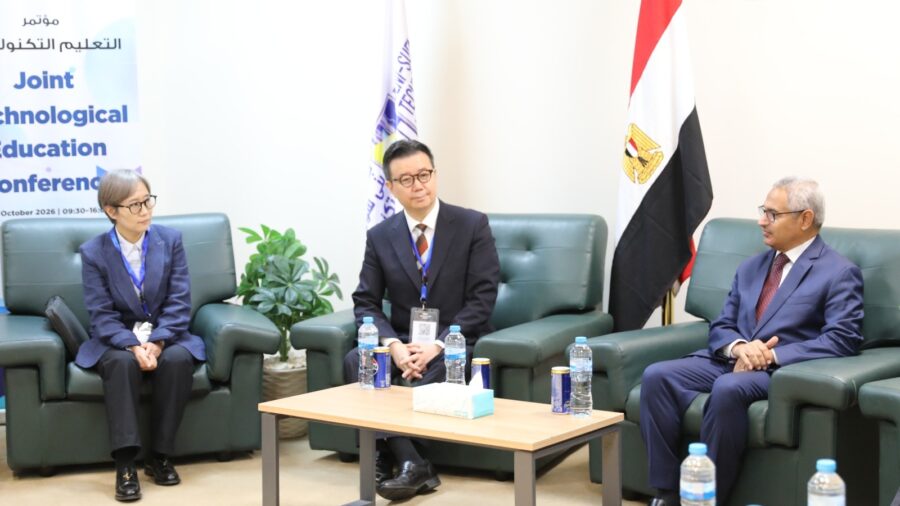
The Korea International Cooperation Agency (KOICA) and Beni Suef Technological University (BTU) recently held the second Technological Education Conference to expand collaboration on technical training in Egypt. The event focused on aligning academic curricula with modern industry requirements, specifically in artificial intelligence and green automotive technologies.
Conference Proceedings
The conference brought together university leaders, industry representatives, and international partners, including the German Agency for International Cooperation (GIZ) and the Italian Agency for Development Cooperation (AICS). Attendees discussed faculty capacity development and the need to modernize curricula to meet shifting labor market demands. During the opening, BTU President Prof. Jean Henry Hanna announced the creation of an Industrial Advisory Council, intended to bridge the gap between academic instruction and industry needs. He also outlined upcoming initiatives for laboratory upgrades and infrastructure expansion at the university.
Bilateral Cooperation
Kim Sang-Hoon, Minister and Consul General of the Embassy of the Republic of Korea, addressed the event by citing Korea’s own economic development history, which prioritized technology and education. He reaffirmed South Korea’s commitment to supporting Egyptian technological universities, including BTU and Helwan International Technological University. These efforts focus on equipping students with practical skills, specifically in vocational training for green automotive maintenance. Beni Suef Governor Dr. Abdullah Abdel Aziz El-Sayed noted the region’s growing industrial base, emphasizing that partnerships between local industries and educational institutions are necessary for sustainable economic growth.
Current Status of Partnership
The collaboration between KOICA and Egyptian educational institutions continues to prioritize youth empowerment through technical training. The partners aim to integrate digital and AI-driven skills into the workforce, fostering a closer connection between academic output and the requirements of the private sector.
 Egypt
 Saudi Arabia
 UAE
 Spain
 United Kingdom
 United States
 China
 India
