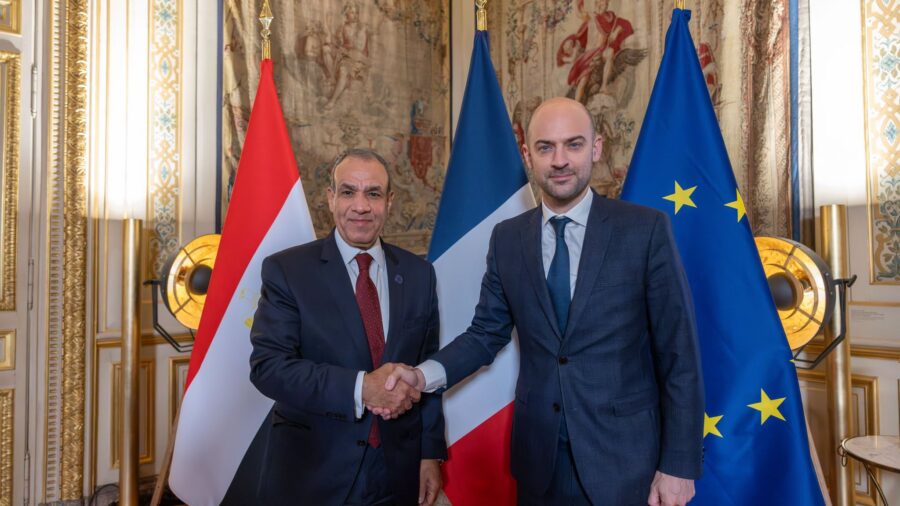
On the sidelines of a G7 ministerial summit in Paris on Tuesday, Egyptian Foreign Minister Badr Abdelatty engaged in a series of high-level meetings to address regional security and economic cooperation. The discussions focused on de-escalation strategies amidst rising geopolitical tensions and ongoing conflicts in the Middle East and Eastern Europe.
Bilateral Ties and Regional Security
Abdelatty met with French Foreign Minister Jean-Noël Barrot to review bilateral economic and infrastructure initiatives, including the development of Cairo Metro Line 6 and financing provided by the French Development Agency. The two ministers noted the elevation of Egyptian-French relations to a strategic partnership scheduled for 2025. Abdelatty urged a diplomatic approach to prevent regional military escalation, warning that a broader conflict could destabilize global energy and food security.
Addressing instability in Sudan, Abdelatty stated Egypt’s commitment to the country’s territorial integrity and national institutions. He condemned drone strikes against civilian infrastructure and advocated for a political process led by the Sudanese people. Similar calls for diplomatic resolution were reiterated regarding the situation in Yemen.
Economic Cooperation and Global Trade
In a discussion with Ukrainian Foreign Minister Andrii Sybiha, Abdelatty explored opportunities to expand trade and energy cooperation. He proposed that Egypt serve as a global hub for grain storage and supply, leveraging the nation’s logistics infrastructure and geographic position. Abdelatty emphasized the necessity of maintaining freedom of navigation in the Black Sea, citing its critical role in grain shipments to Egypt and the broader African continent.
Abdelatty also met with Canadian Foreign Minister Anita Anand to discuss potential trilateral cooperation between Egypt, Canada, and various African nations. Potential sectors for collaboration include renewable energy, healthcare, and infrastructure. The ministers exchanged views on the situation in Gaza and the risks associated with regional tensions involving Iran.