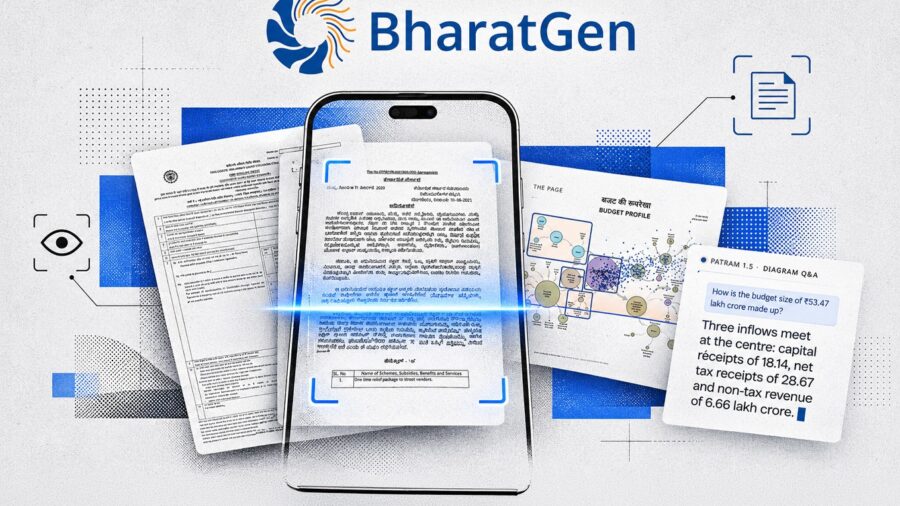
BharatGen, a not-for-profit company anchored at IIT Bombay, has launched Patram 1.5, a vision-language AI model designed to automate document processing for industries including banking, healthcare, and government. The model interprets documents by treating them as images, enabling it to analyze layouts, charts, and tables alongside text.
Expanding Enterprise Capabilities
Patram 1.5 is engineered to handle complex documentation, such as bank statements, KYC forms, medical reports, and invoices. By analyzing visual elements rather than relying solely on raw text extraction, the model aims to understand the relationship between different parts of a page. BharatGen has released the model weights under an Apache 2.0 license and provided a playground for users to test the technology.
A key feature, which the company calls “OCR 3.0,” allows users to define specific information to be extracted and the required output format. Additionally, the model includes an abstention capability designed to flag missing or unclear data rather than generating speculative answers. BharatGen CEO Rishi Bal stated that this function is critical for business workflows where errors carry significant regulatory or financial risks.
Resource Efficiency and Performance
BharatGen is marketing Patram 1.5 as a 7.8 billion parameter model that competes with significantly larger systems. According to the company’s internal evaluations, the model scored 83 on a benchmark of 21 vision-language models, matching the performance of much larger competitors. The company claims the model offers high token efficiency, requiring fewer resources to process queries compared to larger models like Qwen3.5.
The model is compatible with NVIDIA H100, B200, and L40 GPUs. While Bal confirmed that the technology has been deployed in live data centers within the BFSI and governance sectors, he did not disclose specific client names. The company also emphasizes that the model can be deployed locally, a feature intended to support organizations handling sensitive data.