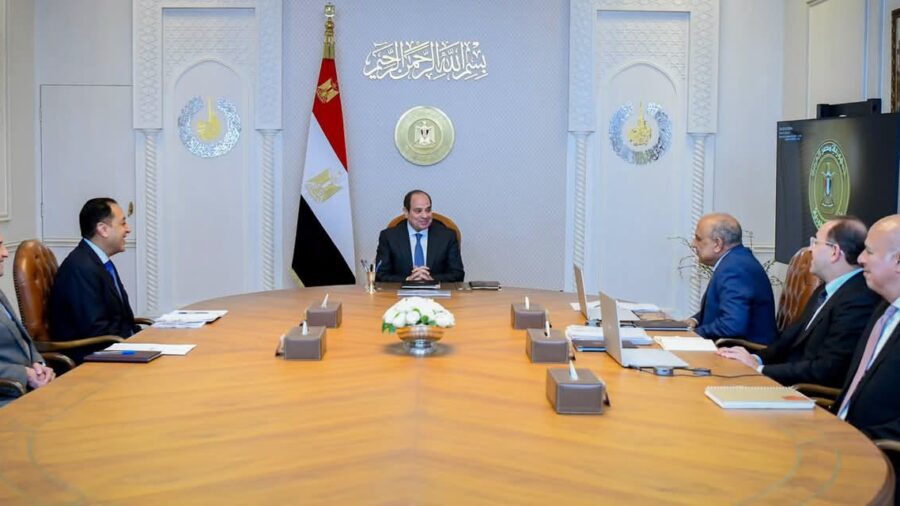
President Abdel Fattah Al-Sisi has directed the government to expedite the nation’s transition to sustainable power. The administration aims to increase the share of renewable energy in Egypt’s electricity mix to 45% by 2028, surpassing a previous goal of 42% by 2030.
Tuesday Meeting
President Al-Sisi met with Prime Minister Mostafa Madbouly, Electricity Minister Mahmoud Esmat, and Finance Minister Ahmed Kouchouk to discuss ongoing energy infrastructure projects. The presidency stated that the discussions focused on integrating more renewable capacity into the national grid and enhancing energy security to reduce fossil fuel dependence.
Grid and Capacity Expansion
The Ministry of Electricity confirmed progress on a 200-megawatt wind power plant situated in the Gulf of Suez. To support this generation, the ministry finalized a contract for a 500-kilovolt overhead transmission line. This infrastructure is designed to transport wind-generated power to primary consumption centers, strengthening the stability of the national electricity grid.
Strategic Diversification
Officials reviewed broader initiatives, including battery energy storage systems, green hydrogen production, and seawater desalination complexes. A specific project in the Dabaa area was highlighted for its use of advanced desalination technology. The government also discussed localizing manufacturing for these technologies and processing black-sand minerals to convert raw resources into higher-value industrial products.
Fiscal Oversight
Finance Minister Ahmed Kouchouk provided updates on the state’s economic strategy. The briefing included progress reports on cooperation with international financial institutions and ongoing efforts to reduce the debt held by budgetary authorities. President Al-Sisi instructed state agencies to coordinate closely to meet these fiscal targets.
Current Status
Egypt is actively recalibrating its energy strategy to prioritize rapid expansion of wind and solar capacity alongside industrial localization. The government remains focused on integrating these projects with national grid upgrades and fiscal reform.
 Egypt
 Saudi Arabia
 UAE
 Spain
 United Kingdom
 United States
 China
 India
