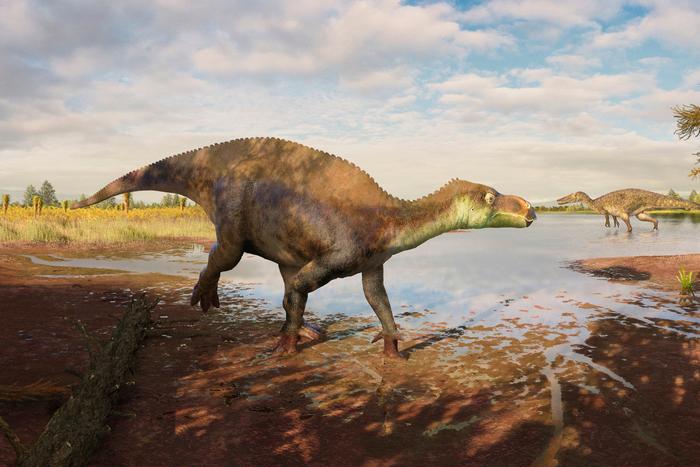
A dinosaur fossil sitting in a London museum collection for over two decades has been identified as a previously unknown species. Researchers confirmed the specimen, originally unearthed in a southern England clay quarry, represents a new genus of herbivorous dinosaur that lived approximately 125 million years ago.
A Discovery in the Archives
The creature, named Paludohadros proudlovii, was recovered in 2001 from a brick and roof-tile factory quarry in Ewhurst, Surrey. The fossils were later moved to the Natural History Museum in London. For years, palaeontologists categorized these remains alongside other known iguanodontian fossils, a widespread group of plant-eating dinosaurs from the Early Cretaceous Period.
Ricardo Sacamoto, a PhD researcher at the Natural History Museum and the University of São Paulo, led the study published on October 27 in the Journal of Systematic Palaeontology. Sacamoto explained that the genus name derives from the Latin word for swamp, reflecting the muddy wetland environment of prehistoric southern England. The species name honors Will Proudlove, a former quarry manager who died shortly before the fossils were found.
Anatomical Analysis
The re-examination of the specimen revealed anatomical differences previously overlooked. While previous classifications grouped the find with other British dinosaurs, new analysis suggested a distinct species. The fossilized individual measured roughly five metres long and weighed between 1.5 and two tonnes. Because the bones were not fully developed, researchers believe the animal was a juvenile. Adults may have grown significantly larger, though exact dimensions remain uncertain.
The fossil was discovered less than 100 metres from the site where remains of the predatory dinosaur Baryonyx were found in 1983. Scientists are currently reviewing museum collections, leading to the identification of several new iguanodontian species.