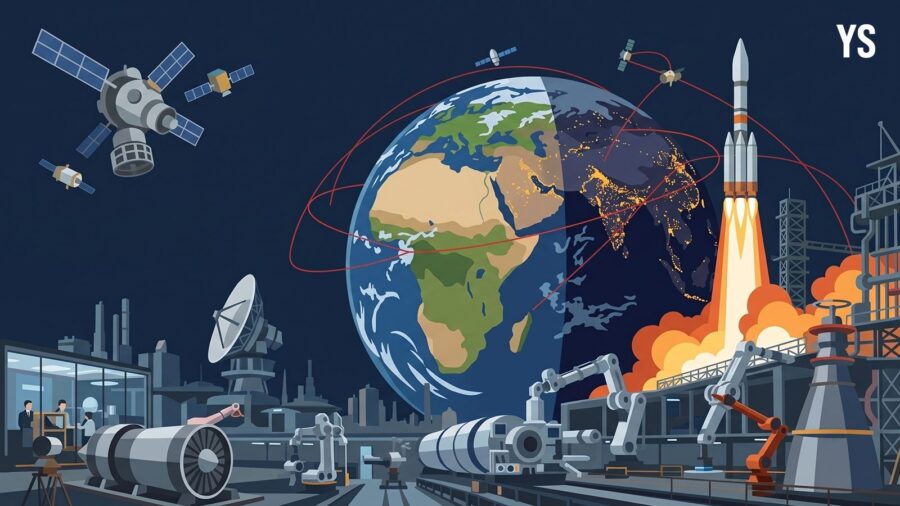
India’s private space sector is expanding, with industry experts suggesting that future economic opportunities lie in developing a comprehensive space infrastructure rather than solely focusing on rocket manufacturing. The sector gained momentum as Skyroot Aerospace achieved a $1 billion valuation in May 2026, followed by its Vikram-1 rocket becoming the first privately developed Indian vehicle to reach orbit in July 2026.
May 2026
Skyroot Aerospace reached a valuation of $1 billion, marking India’s first space-tech unicorn. This milestone signaled a shift in the domestic ecosystem from aspirational projects to operational businesses.
July 2026
The Vikram-1 rocket successfully reached orbit. This flight established the viability of privately developed launch vehicles in the Indian market, proving that commercial access to space is technically feasible.
Future Development Phases
Analysts suggest the space economy will develop in layers. The initial focus remains on reliable, repeatable access to orbit through reusable launch systems. Once access is established, the next phase involves building orbital infrastructure, such as communication networks, platforms, and servicing systems. Following this, industry experts anticipate the rise of in-space manufacturing and resource utilization, enabled by the vacuum and microgravity environment. Finally, robotics and life-support systems will likely be deployed to facilitate sustained human habitation.
The Next Economic Frontier
The government estimates the domestic space economy could reach significant scale, moving beyond launch services to include propulsion, satellite servicing, and advanced materials. Future industry leaders may emerge from sectors currently not classified as space companies, such as robotics or data analytics.
Why it matters: India’s strategic focus on building a multi-layered space economy offers a blueprint for emerging markets. By prioritizing infrastructure and supply chain development, the nation aims to transition from a single-product industry to a sustainable ecosystem, providing a roadmap for other nations seeking to establish technological independence in the aerospace sector.