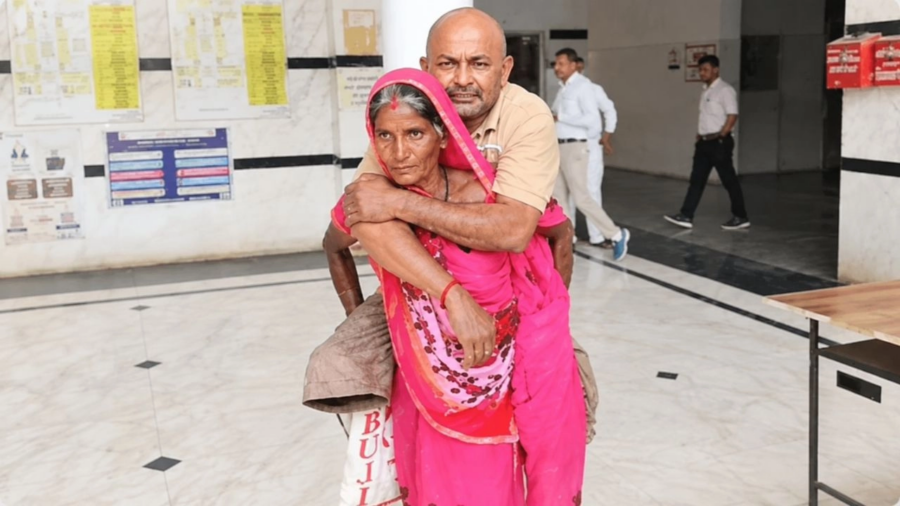
A 60-year-old woman in Madhya Pradesh entered the Burhanpur collectorate carrying her paralysed husband to demand a disability pension and a tricycle, prompting immediate government assistance.
Key takeaways
- Direct intervention: Chief Minister Mohan Yadav ordered swift aid after seeing the viral video.
- Immediate relief: The couple received a tricycle and support for their daughters’ education.
- Long‑standing disability: Dayashankar has been paralysed for nine years and lost a leg during treatment.
- Gender burden: A 2024 survey shows women in India perform unpaid caregiving at twice the rate of men.
- Broader relevance: The incident highlights systemic gaps in disability support and women’s unpaid care work.
Video sparks official response
The video, posted Saturday night, shows Bindubai lifting her husband, Dayashankar, onto her back as they approach collector Vivek Kumar. She says officials had told her she would receive nothing. The clip reached Chief Minister Mohan Yadav, who instructed that the family be helped without delay.
Assistance provided
According to NDTV, the government supplied a three‑wheel tricycle to aid Dayashankar’s mobility and arranged financial support for the couple’s two daughters to continue schooling. The aid was delivered after the grievance hearing at the collectorate.
Background of the couple
Bindubai and Dayashankar live in Mahajan Colony. Dayashankar became paralysed nine years ago, and a leg was amputated during medical treatment. He has been unable to walk since, and his wife carries him for any travel. She holds a medical certificate confirming his condition.
Wider context of unpaid care
The Ministry of Statistics and Programme Implementation’s Time Use Survey 2024 found that 34% of women aged six and above performed unpaid caregiving on the survey day, compared with 17.9% of men. Bindubai’s effort reflects a broader pattern of women shouldering the bulk of home‑based care responsibilities.