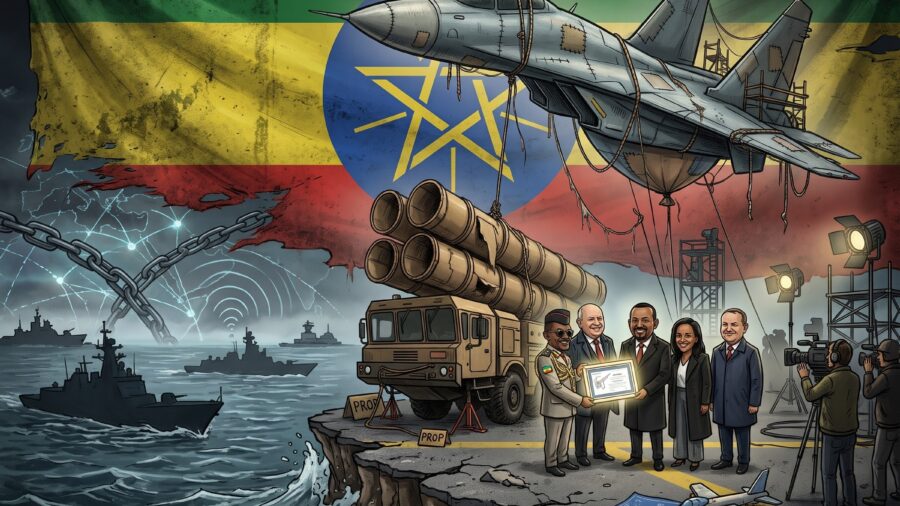
Ethiopia’s potential acquisition of advanced Russian military hardware, including Su-35 fighter jets and S-400 air defense systems, faces significant challenges in altering the regional balance of power. Analysts suggest that the Horn of Africa remains constrained by an existing network of foreign military bases and complex security arrangements.
Strategic Saturation
The Horn of Africa and the Red Sea region are densely populated with foreign military installations due to their proximity to the Bab el-Mandeb Strait. Djibouti hosts bases from the United States, China, France, Japan, and Italy, alongside European contingents. Somalia accommodates military operations from the U.S., Turkey, and the United Arab Emirates. Meanwhile, Israel maintains surveillance facilities in Eritrea, and Russia has secured agreements to utilize port facilities at Massawa.
Regional Security Frameworks
Beyond direct foreign bases, the region operates under several institutional security frameworks. The African Union and the United Nations support the Somali government against Al-Shabaab, utilizing forces from Uganda, Burundi, Kenya, Djibouti, and Ethiopia. Additionally, the Council of Arab and African States Bordering the Red Sea and the Gulf of Aden facilitates security coordination among members including Saudi Arabia, Egypt, Jordan, Sudan, Djibouti, Somalia, and Eritrea.
The Question of Military Efficacy
Speculation regarding Ethiopia’s ability to use new aircraft to deter actions against the Grand Ethiopian Renaissance Dam ignores operational realities. Military observers argue that the effectiveness of such assets depends more on deployment capabilities than on the acquisition of the hardware itself. The presence of private security contractors, such as the Africa Corps, further complicates the regional security landscape.
Current Standing
The Horn of Africa remains a crowded geopolitical theater. While new arms acquisitions are proposed, the existing density of foreign bases and regional alliances suggests that strategic shifts remain difficult to achieve.