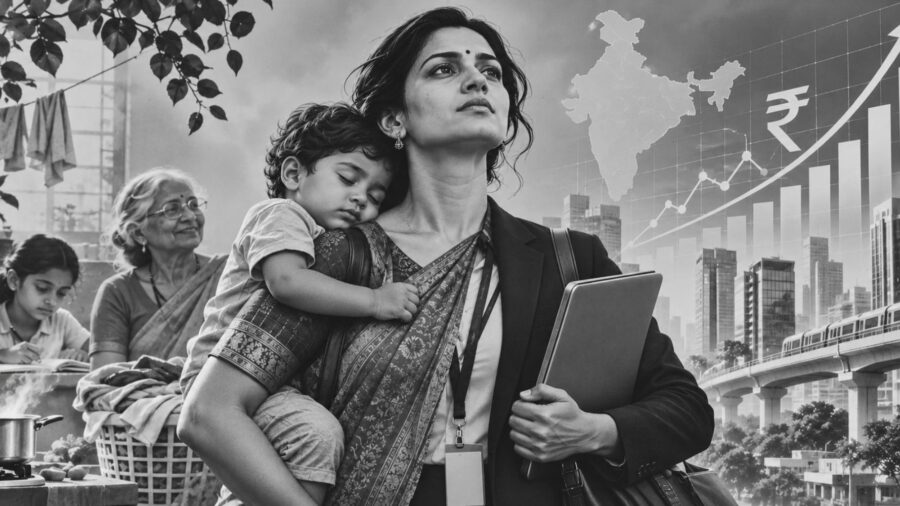
Measuring the Invisible Economy
In February 2026, India updated its GDP base year to 2022-23, integrating new data sources to better capture the informal economy. While the government reported a 7.8% growth rate, maintaining India’s status as a major global economy, a significant portion of labor remained uncounted. Unpaid domestic and care work, performed primarily by women, falls outside the formal production boundary used to calculate national output.
Data from India’s 2024 Time Use Survey indicates a stark disparity in labor distribution. Women aged 15 to 59 dedicate approximately 343 minutes daily to unpaid household tasks, compared to 43 minutes for men. Approximately 93% of women engage in this labor, versus 44% of men. The Ministry of Women and Child Development estimates the value of this unpaid work at up to Rs 34.5 lakh crore, representing between 15% and 17% of the nation’s GDP.
Policy Implications of Uncounted Labor
The exclusion of these services means GDP figures underestimate total national income. According to the United Nations Development Programme (UNDP), 44.5% of Indian women outside the formal labor force identify childcare and homemaking as their primary responsibility. Although female labor-force participation rose from 23.3% in 2017-18 to approximately 40% in 2025, the burden of unpaid work has remained largely unchanged.
Experts suggest that implementing a satellite account to measure activity beyond the current production boundary could provide a more accurate economic picture. This would involve utilizing existing data from national time-use surveys and established valuation methods. Without systemic changes, women entering the paid workforce often face a “second shift,” balancing professional duties with domestic responsibilities. Developing infrastructure that integrates paid employment with caregiving remains a primary challenge for policymakers.