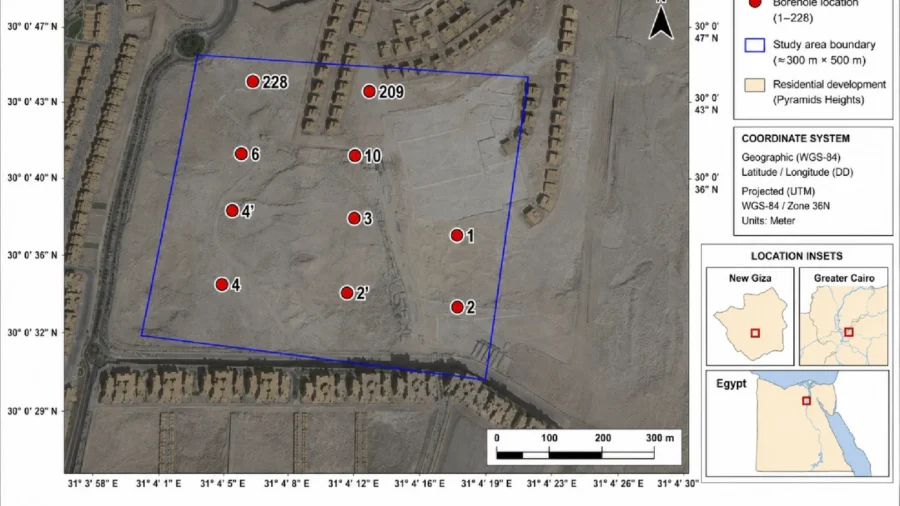
A study published in Discover Geoscience on September 20 indicates that the limestone foundation beneath New Giza varies significantly in stability. Researchers from Ain Shams University analyzed rock samples to determine how geological history affects the load-bearing capacity of the area’s construction sites.
Key Findings
- Geological variability: The study found that rock strength is not uniform, with some layers requiring reinforcement before building.
- Testing methodology: Researchers analyzed 228 boreholes and tested 12 samples to measure pressure tolerance.
- Performance gap: Safe bearing capacity varied widely, ranging from 1.25 to 4.99 megapascals across different layers.
- Strongest foundation: The Acteonella Series proved the most reliable, supporting loads up to 5.0 megapascals.
- Weakest material: The Flint Series, characterized by porous limestone and marl, showed the lowest stability.
- Engineering solutions: Experts suggest using pressure grouting or micropiles to stabilize weak or fractured ground.
Assessing Underground Risks
Lead author El-Hussein M. Ali and his colleagues examined carbonate rocks from the Abu Roash Formation. The team found that the rocks retain a geological history that influences current structural integrity. Factors such as water dissolution and ancient fault lines have created voids and weak pockets beneath the surface.