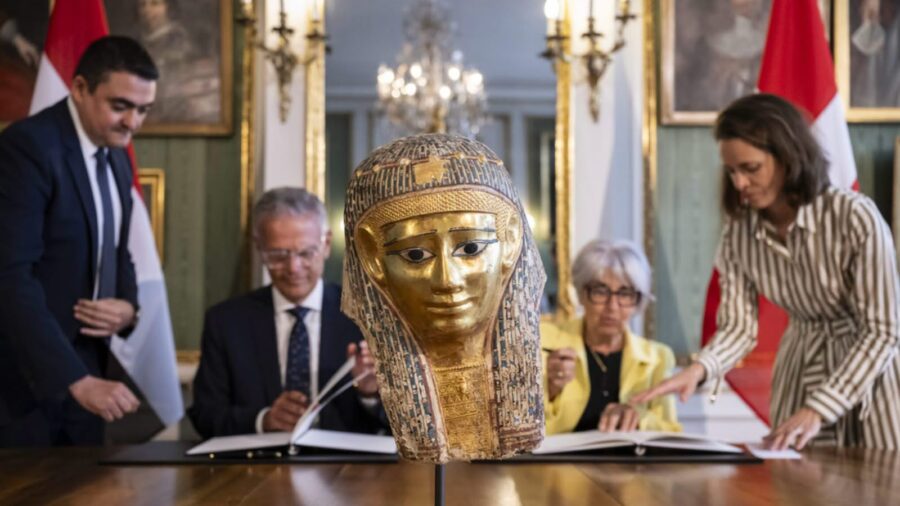
A Journey Home: Ancient Mask Returns to Egypt
In a significant victory for international cultural heritage preservation, a funerary mask dating back over two millennia has finally returned to its country of origin. This rare artifact, a silent witness to the grandeur of the Ptolemaic era, was officially repatriated to Egypt following a successful intergovernmental operation involving Swiss customs and cultural authorities. The return of the mask marks yet another successful chapter in the ongoing global effort to curb the illicit trafficking of antiquities.
The artifact’s odyssey back to the Nile Valley began in September 2022, when Swiss customs officials at the Bardonnex border crossing in Geneva intercepted the item. Recognizing the potential significance of the piece, authorities immediately detained it, setting in motion a rigorous process of investigation and authentication. This decisive action prevented what could have been the permanent loss of a piece of human history to the black market.
Authentication and Diplomatic Cooperation
Following the initial seizure, the Swiss Federal Office of Culture took control of the mask, commissioning an expert examination to verify its provenance. The subsequent analysis by a specialist in Egyptology confirmed that the mask was indeed an authentic antiquity, crafted during the middle of the Ptolemaic period—a time of immense cultural synthesis and artistic development in Egypt.
The formal repatriation ceremony took place in Bern, where Swiss Federal Councillor Elisabeth Baume-Schneider officially handed over the artifact to Egypt’s Ambassador to Switzerland, Mohamed Negm. This event was not merely a bureaucratic handover but a symbolic reinforcement of the strong bilateral ties between the two nations, grounded in a shared commitment to protecting global heritage.
A Decade of Collaborative Protection
The successful return of this funerary mask is not an isolated incident; rather, it is a testament to the efficacy of a longstanding partnership. Since 2011, Switzerland and Egypt have maintained a robust bilateral agreement specifically designed to regulate the import, transit, and return of cultural property. This framework has proven to be a vital tool in disrupting the networks that profit from the theft and smuggling of historical treasures.
The impact of this cooperation is substantial, with Switzerland having returned approximately 80 cultural objects to Egypt under the current agreement. These items range from small statuettes to significant funerary artifacts, all of which have been recovered from illicit transit routes and returned to their rightful home.
The Global Fight Against Antiquities Trafficking
The illicit trade in cultural property remains one of the most challenging issues facing archaeologists, historians, and law enforcement agencies worldwide. Trafficked antiquities are often stripped of their context, erasing the historical narrative that allows scholars to understand the lives of those who came before us.
Several key factors drive the necessity for continued vigilance:
- Historical Integrity: Artifacts lose their scientific and historical value when removed from their original archaeological context without proper documentation.
- Preventing Exploitation: The black market for antiquities often funds criminal enterprises and conflict, making the fight against trafficking a matter of global security as much as cultural preservation.
- National Identity: For nations like Egypt, whose history is deeply intertwined with their modern identity, the return of these objects is a matter of national pride and cultural restitution.
Egypt’s relentless pursuit of its stolen heritage continues to serve as a model for other nations seeking to reclaim their history. By working closely with international partners like Switzerland, Egypt is slowly piecing back together a fragmented past, ensuring that future generations can appreciate these masterpieces in their proper context. As this 2,000-year-old mask is now prepared for its return to public view in an Egyptian museum, it serves as a poignant reminder that while the past may be lost for a time, it is never truly gone.