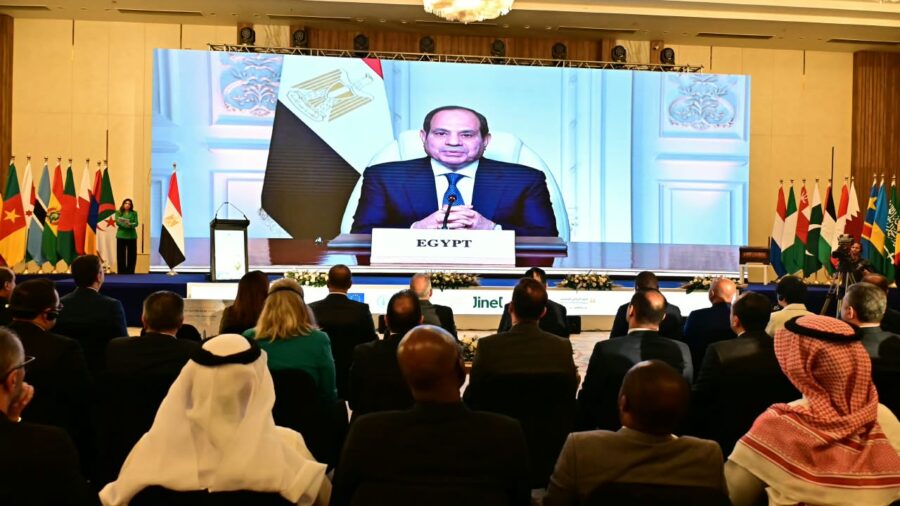
Egyptian President Abdel Fattah Al-Sisi declared on Sunday that his nation will not accept any unilateral actions concerning the Nile River, emphasizing that the country’s water security remains non-negotiable. Speaking at the opening of the ninth Cairo Water Week, Al-Sisi asserted that no single nation possesses the right to exercise exclusive control over shared water resources.
Sunday, October 24
Al-Sisi delivered a recorded address to open the conference, which runs through October 29. He noted that the Nile supplies over 98% of Egypt’s renewable water. The president stated that while Egypt supports the development goals of all Nile Basin countries, such progress must not occur at the expense of other states or cause them harm. He characterized any assumption that Egypt would accept a “fait accompli” regarding water security as a “losing bet.”
Conference Proceedings
The event, themed “Water as a Catalyst for Peace, Shared Prosperity and a Sustainable Planet,” includes 21 ministers and 23 high-level delegations. Water Resources and Irrigation Minister Hani Sewilam addressed the session, detailing Egypt’s “Water System 2.0” program. This initiative involves upgrading infrastructure, expanding water treatment, and utilizing artificial intelligence to monitor canal flow. Sewilam stated that Egypt seeks to use water as a tool for regional cooperation rather than conflict.
Current Status of Nile Water Negotiations
Egypt maintains that it prefers dialogue to resolve disputes over the Nile’s resources. The government continues to advocate for a management framework that maximizes shared benefits among Egypt, Sudan, and Ethiopia. Officials reiterate that while Cairo prioritizes cooperation and international law, it will continue to protect its national water rights.
Why it matters: Water scarcity is a critical national security issue for Egypt, which relies almost entirely on the Nile for its agricultural and consumption needs. As population growth and climate change increase pressure on these resources, the government’s stance on the river’s management remains a central pillar of its foreign and domestic policy in the Middle East and North Africa.
 Egypt
 Saudi Arabia
 UAE
 Spain
 United Kingdom
 United States
 China
 India
