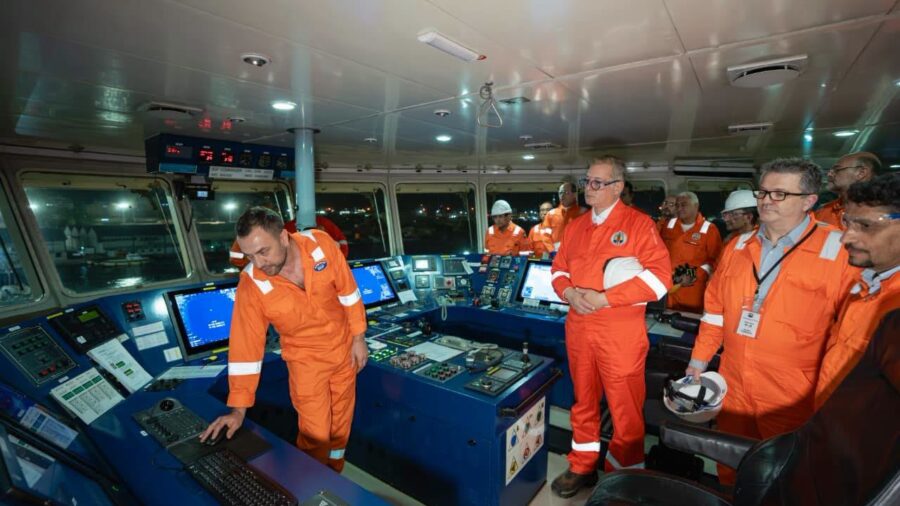
Minister of Petroleum and Mineral Resources Karim Badawi visited the Commander vessel at Port Said Port this week to inspect preparations for a large-scale seismic survey project. The operation, set to launch on October 30, aims to map subsurface geological formations across Egypt’s eastern Mediterranean waters.
Technology Drives Efficiency
The Ministry has increasingly deployed Ocean Bottom Node (OBN) technology to improve its exploration efforts. According to Badawi, this specific technology has already yielded significant results in the Gulf of Suez, where drilling success rates increased from 26% to 80%. Officials stated that the use of advanced seismic data allows for more accurate targeting, which reduces exploration risks and operational costs.
The upcoming Mediterranean project is managed by the Egyptian Natural Gas Holding Company (EGAS) in partnership with an international consortium consisting of SLB and Viridien. The initiative is designed to generate high-resolution geological data, which officials say will assist in identifying potential natural gas reserves.
Future Exploration Strategy
Henning Berg, CEO of Viridien, noted that his company has managed approximately 80% of OBN seismic operations globally. He stated that the firm will apply experience gained from similar projects in the United Arab Emirates and Saudi Arabia to the Egyptian effort. This data will be integrated with existing information from the Nile Delta to create a comprehensive overview of the nation’s geological potential.
Badawi emphasized that the accuracy of seismic data remains a primary factor in attracting international oil companies to invest in new exploration zones. By minimizing uncertainty regarding geological formations, the ministry aims to foster an environment conducive to new discoveries.
Why it matters: This initiative is part of a broader strategy to maximize Egypt’s natural gas resources. For stakeholders in the Middle East and Egypt, the successful application of this technology is critical for streamlining investment, reducing exploration costs, and securing future energy supplies in the eastern Mediterranean.
 Egypt
 Saudi Arabia
 UAE
 Spain
 United Kingdom
 United States
 China
 India
