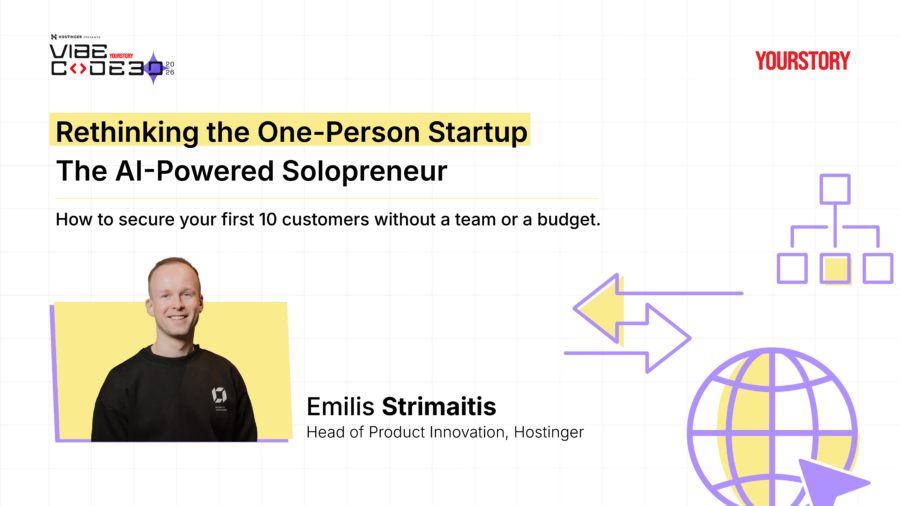
At a TechSparks 2026 webinar, Hostinger’s Head of Product Innovation Emilis Strimaitis urged founders to prioritize selling before building, even as AI accelerates development.
Key takeaways
- Sell before you build: Strimaitis says every successful venture began with pre‑sales, while failures started with product‑first approaches.
- AI speeds execution, not idea validation: AI can create a shopping app in a weekend, but market demand still determines success.
- Identify a niche using three checks: know the target audience, locate them online, and confirm they already pay for solutions.
- Leverage complaints as a roadmap: gather about 50 recurring negative reviews to pinpoint unmet needs.
- Test promises with landing pages: craft ten value propositions, launch simple pages, and collect pre‑orders or wait‑list sign‑ups.
Why selling first matters
Strimaitis, who has bootstrapped 15 businesses generating over $10 million without external funding, notes that a tool sold before development cost roughly $100 to create and earned $29,000. By contrast, a $40,000 platform built without proof of demand failed to attract customers.
AI’s role in the new workflow
According to the speaker, AI replaces manual coding but does not eliminate the need for market research. He described a scenario where founders use AI to build a product, add automated agents to run it, then add more agents to manage those agents—yet still end up with zero customers, likening it to a self‑driving car without roads.
Step‑by‑step selling machine
The suggested seven‑step process begins with niche selection using the three checks, followed by mining online reviews for recurring pain points. AI can group complaints into top problems, but creators must avoid letting AI invent solutions. After defining ten distinct promises, founders launch minimal landing pages to gauge interest and secure pre‑orders before any code is written.
Why it matters: The approach highlights that even in the AI‑driven era, Egyptian and regional entrepreneurs must validate demand early to avoid costly missteps, ensuring limited resources are directed toward products that customers are already willing to pay for.
 Egypt
 Saudi Arabia
 UAE
 Spain
 United Kingdom
 United States
 China
 India
