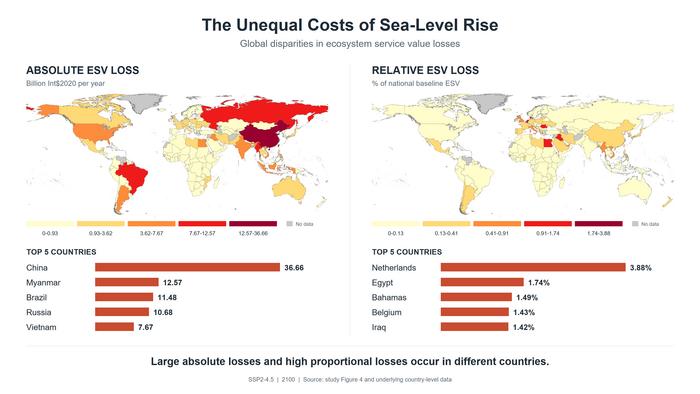
Coastal communities worldwide face the potential loss of hundreds of billions of dollars in natural resources as rising sea levels threaten to submerge critical ecosystems. A study published November 3 in PNAS Nexus quantifies the economic toll of these losses, which include natural storm protection, water filtration, and food production.
Global Economic Impact
Researchers combined sea-level rise projections from the Intergovernmental Panel on Climate Change with global land-use maps to estimate potential damage between 2030 and 2100. The study models five future scenarios, ranging from significant emissions reductions to high-emissions pathways. Under an intermediate scenario, annual global losses could reach approximately $164 billion. In a high-emissions scenario, this figure rises to roughly $339 billion.
Shaoqing Long, lead author and associate professor at Sun Yat-sen University, noted that the research aimed to determine how ecosystem-service losses vary by nation. The study assessed the benefits nature provides, such as carbon storage, tourism, and pollution removal. These figures do not reflect direct government expenditures, but rather the annual economic value of services lost as land is inundated.
Disproportionate Consequences
The study indicates that economic damage will not be distributed evenly. Nations that have historically contributed less to global greenhouse gas emissions may face disproportionately large losses relative to their total natural resource value. This includes several small coastal nations, as well as countries like Egypt and Iraq, which are among those most exposed to these economic risks.
The research team compared each country’s cumulative per-capita greenhouse gas emissions from 1850 to 2024 against projected losses. As sea levels continue to rise, the findings suggest that the disparity between historical emissions and future climate-driven economic vulnerability will likely widen.